What is a good aptitude test score? Raw scores and percentiles
Updated October 12, 2026 · 5-minute read · 6 sections

Asking for a good aptitude test score is like asking for a good running time without naming the race: the answer depends on who else ran it. Your raw score is just the count of correct answers; what an employer sees is where that count sits among other people.
Raw score first
A raw score is what you got: 11 correct out of 15 is 11 / 15 = 73%. The percentage is a convenient way to compare your own attempts with each other, because the questions and conditions are the same kind. It says nothing about how hard the items were or how strong the people who took the test were. Skipped questions count as not correct, which is also how most real tests treat them.
Norm groups and percentiles
Employers do not usually read a raw number. They read it against a norm group: other applicants, or a reference population. The official Civil Service guidance gives the plain meaning: results are shown as a percentile against the applicant group, and a percentile of 44 means you scored better than 44% of that group.
The Watson-Glaser publisher reports percentiles, T-scores, stanines and stens against a norm group. These are not four different tests of you; they are four ways of writing down the same position.
The same raw score can mean different things. Picture two hypothetical applicant groups for different roles. In group X most people score between 8 and 10 of 15; in group Y most score between 11 and 13. A raw 11 is above the middle in group X and below it in group Y. The test did not change; the comparison did. That is the reason a number from a free practice site cannot be turned into a percentile by arithmetic.
What the common score scales mean
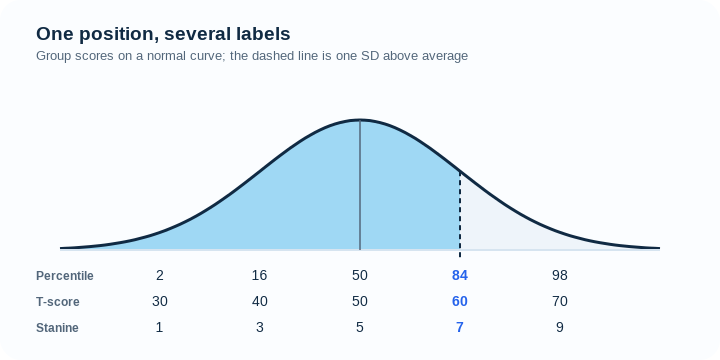
These are standard conventions in test reporting. Where the scores follow a normal curve, they line up like this:
| Scale | Average | Spread (SD) | Range | One SD above average |
|---|---|---|---|---|
| Percentile | 50 | - | 1-99 | About 84 |
| T-score | 50 | 10 | about 20-80 | 60 |
| Stanine | 5 | 2 | 1-9 | 7 |
| Sten | 5.5 | 2 | 1-10 | 7.5 |
As a quick reference on a normal curve, a T-score of 40 sits at about the 16th percentile, 50 at the 50th, 60 at the 84th and 70 at the 98th. Stanines split the group into nine bands holding roughly 4, 7, 12, 17, 20, 17, 12, 7 and 4 percent, so stanine 5 is the broad middle fifth. Real reports use the publisher's own tables, which can differ a little from this idealised curve, so use the numbers above for understanding, never for converting an actual result.
So what is a good score?
Nobody can give you an honest cut-off, and anyone who quotes one for "an aptitude test" in general is guessing. The employer decides the bar, which can differ by role, by stage and by how many applicants there are. What you can say is this: a percentile well above 50 in a sensible norm group is a strong position, a percentile near 50 is typical, and below that you still may pass, depending on the other stages. The practical goal is not a magic number but the best version of your own performance, with no section that collapses.
Pace shapes a score too. If a test does not deduct for wrong answers, an unanswered item can only cost you, so check the rules and leave nothing blank when time is nearly gone.
What to do with a weak section
- Compare your topic percentages inside the same attempt. A gap of one or two sections is useful signal; a gap of one or two questions is noise.
- Open the review for the weak section and sort mistakes into four causes: misread the item, wrong method, arithmetic slip, ran out of time.
- Fix the most common cause first. A timing problem needs pace practice; a method problem needs the worked explanations.
- Practise in practice mode until the method is steady, then move back to the exam clock.
- Retake the section. It draws new questions and reshuffles the options, so a better score reflects better reasoning rather than a remembered key.
The section-specific guides help here: numerical reasoning test tips covers percentages, tables and pace, and true, false or cannot say covers verbal items.
Retakes and what you can control
Practising with fresh questions is the honest way to improve, because it trains the skill rather than the memory of one set. Real retake rules belong to the employer, so ask the recruiter before you plan around one. If you have a condition that affects how you take a timed test, the Civil Service guidance notes that reasonable adjustments can be requested, and many other employers offer the same; ask early.
- Use a larger screen than a phone, as the official guidance recommends.
- Have rough paper, a pen and, where allowed, a calculator ready before you click start.
- Do not compare your percentage on one practice site with a friend's on another; different items mean different difficulty.
- Do not read a high practice score as a prediction. Pure guessing on 15 four-option items averages 25%, so a practice score well above that reflects reasoning, but it still is not a ranking.
When you are ready, try the sections on the free aptitude test, look at your history of attempts, and aim for steady improvement from one attempt to the next.
Common questions
What is a good score on an aptitude test?
There is no universal figure. Employers set their own bar and read your result against a norm group. A percentile well above 50 is a strong position, but the pass mark is the employer's decision.
Is my practice percentage the same as a percentile?
No. A practice percentage is the share of questions you answered correctly. A percentile says what share of a norm group you scored better than, and this site has no norm data.
What does a percentile of 44 mean?
The official Civil Service guidance explains it: you scored better than 44% of the applicant group.
What are T-scores, stanines and stens?
They are standard ways of writing the same position in a norm group: a T-score has an average of 50 and a spread of 10, a stanine runs from 1 to 9 with an average of 5, and a sten runs from 1 to 10 with an average of 5.5.
Can I fail an aptitude test?
Employers usually set a threshold, and a result below it can end an application. How strict it is varies by role and employer, which is why the best preparation is steady improvement across every section.

