True, false or cannot say: how verbal reasoning answers are marked
Updated October 12, 2026 · 6-minute read · 6 sections

Two candidates read the same passage; one answers from what she knows about the world, the other from what the text says. On a true, false or cannot say item only the second candidate is marked right, and learning to be that candidate is worth more than any amount of speed reading.
The rule, as the official guidance states it
The UK Civil Service verbal test asks exactly this question for each statement, and its candidate guidance spells out the three-way split. Employers who use a similar format usually follow the same logic, but test publishers differ in the details, so read the instruction page that opens before your timed section.
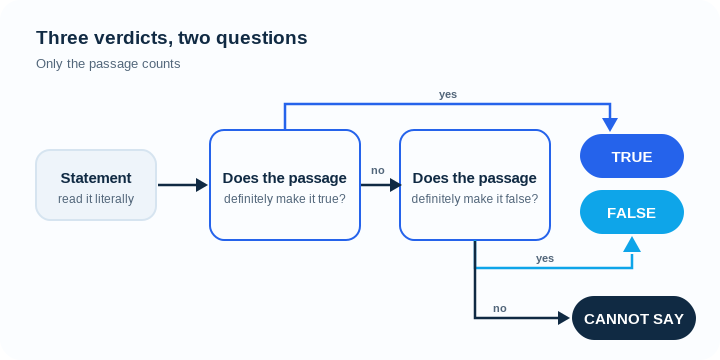
That last sentence is the one to internalise. "Cannot say" is not a middle option for when you feel unsure; it is a precise verdict meaning the passage does not settle the statement either way.
One passage, six statements
Read this short passage once, slowly, then judge each statement before you read my verdict.
| Statement | Verdict | Why |
|---|---|---|
| The reading room seats forty readers. | True | Stated directly. |
| The reading room is open on Saturdays. | Cannot say | Only weekday hours are given; the passage is silent about weekends. |
| Readers may hold conversations in the reading room. | False | Silent study is required there. |
| Fewer than half of the visitors are students. | False | "Most" means more than half, so this is ruled out. |
| More than three quarters of visitors are students. | Cannot say | "Most" sets a floor, not a ceiling. |
| The east wing is the largest part of the library. | Cannot say | Nothing in the passage compares sizes. |
Notice what happened with Saturdays. You probably felt the room is closed at weekends, because libraries often are. That feeling is outside knowledge. The passage gives weekday hours and says nothing about the rest, so the verdict is cannot say, and this is the single most common way to lose marks.
Small words that carry the verdict
Most disputes over an item come from one word. Learn how each quantifier behaves and half the ambiguity disappears.
| Passage says | Statement | Verdict |
|---|---|---|
| Sales rose in every region. | Sales rose in the north. | True |
| Sales rose in most regions. | Sales rose in the north. | Cannot say |
| Some staff work remotely. | Some staff work in the office. | Cannot say |
| Only members may borrow books. | Non-members may not borrow books. | True |
| The shop opens at nine on weekdays. | The shop is closed on Sunday. | Cannot say |
| The report recommends changing supplier. | The supplier is unreliable. | Cannot say |
The last row shows a trap in a different family: a recommendation is not a reason. The passage tells you what the report advises, not why, so you cannot say whether the supplier is unreliable.
Five traps I see again and again
- Outside knowledge. If you find yourself thinking "well, in reality...", stop. The passage is the whole universe for that item.
- Over-using cannot say. If the passage actually contradicts the statement, the answer is false even when it feels like hair-splitting. Cannot say is for silence, not for disagreement.
- Two-part statements. "The room seats forty readers and opens at eight" is false, because one part is contradicted by the opening hours. "The room seats forty readers and is open on Sundays" is cannot say, because one part is supported and the other is not settled. A false part makes the whole false; an unsettled part makes the whole unsettled.
- Changed wording. "May", "will", "was" and "should" are not interchangeable. A passage that says a plan may go ahead does not make "the plan will go ahead" true.
- Passage definitions. If the passage defines a word its own way, use that definition, even if it differs from your own.
Where this fits among critical-thinking tests
The Watson-Glaser critical-thinking appraisal, published by Pearson TalentLens, has 40 items in 30 to 40 minutes, which is about 45 seconds per item at the shorter limit. Its five subtests are named Drawing Inferences, Recognising Assumptions, Deducing, Interpreting and Evaluating Arguments. The publisher names them; the one-line readings below are my own plain-language take on what the names ask of you.
| Subtest | What it asks of you |
|---|---|
| Drawing Inferences | Judge how far a conclusion is supported by the facts given. |
| Recognising Assumptions | Spot what a statement takes for granted without saying so. |
| Deducing | Decide what must follow from the premises, and what does not. |
| Interpreting | Weigh whether a conclusion follows beyond reasonable doubt from the information. |
| Evaluating Arguments | Separate strong, relevant arguments from weak or off-point ones. |
The common thread with true, false or cannot say is discipline about evidence: say only what the text licenses. If that habit is solid, every one of those subtests gets easier.
How to practise it
- Start in practice mode so each answer comes with an explanation, and read the explanation even when you were right.
- For every statement, write one word before you choose: the passage sentence you rely on. If you cannot point to one, the answer is cannot say.
- Switch to exam mode at about 45 seconds per verbal item. The pacing report then shows which passages ate your time.
- Keep a list of the quantifiers that tripped you; most people have two or three favourite blind spots.
When the verbal side feels steady, move to data work with numerical reasoning test tips, and see how to read your result in what is a good aptitude test score. The timed sections themselves are on the aptitude test practice page.
Common questions
What is the difference between false and cannot say?
False means the passage definitely contradicts the statement. Cannot say means the passage neither confirms nor contradicts it, so it is simply silent on the point.
Can I use my own knowledge on a true, false or cannot say question?
No. The statement is judged on the passage alone. Outside knowledge is a common reason for wrong answers, even when that knowledge is correct.
How do I handle a statement with two parts?
If either part is contradicted, the whole statement is false. If one part is supported and the other is not settled by the passage, the answer is cannot say. It is true only when both parts are supported.
How does the word most affect the answer?
Most means more than half, so it rules out fewer than half but does not support all or more than three quarters, which leaves those as cannot say.
Is the Watson-Glaser test the same as true, false or cannot say?
Not exactly. The Watson-Glaser has 40 items in five subtests, and all of them train the same habit of saying only what the evidence supports. The three-way verdict is the format used in the Civil Service verbal test.

